





Sports Wear
High-performance fabrics

Why the decisions made at the spinning mill shape everything downstream.
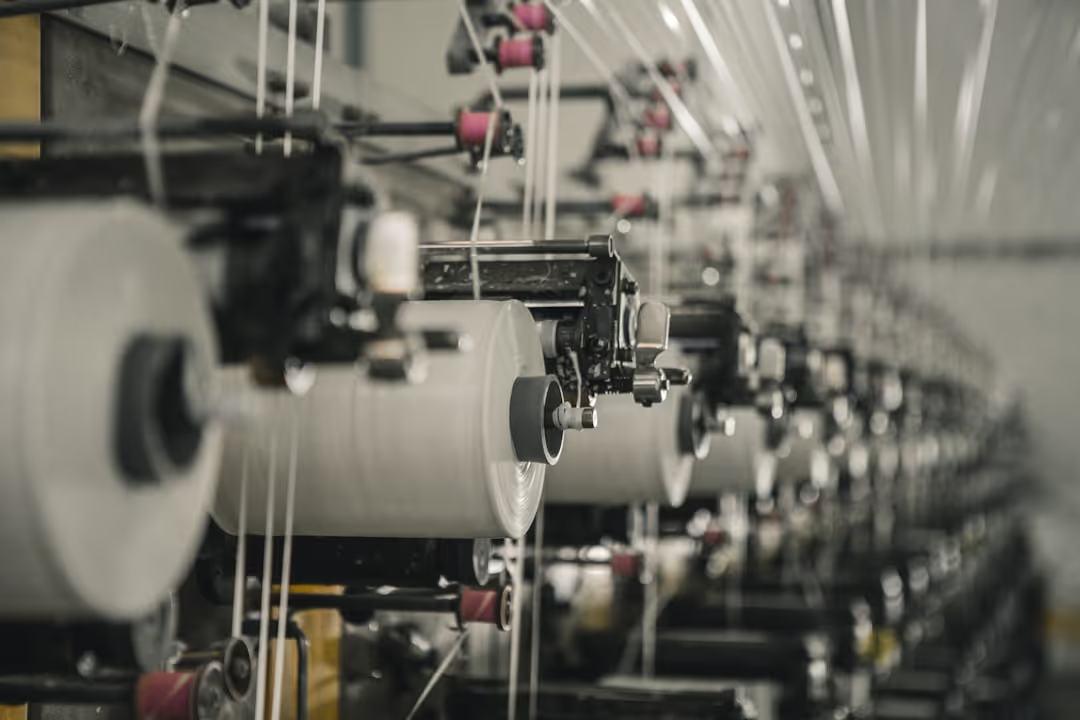
Most buyers start a fabric conversation with GSM and composition. Both matter, but they're the result of decisions made much earlier, at the spinning mill. The fiber that's chosen, how long it is, how it's spun and how fine the yarn is will shape the feel, strength, pilling and price of your garment before a single loop is knitted.
You don't need to become a spinner to source well. But knowing a few basics will help you read a fabric spec, ask the right questions and understand why two fabrics that look the same on paper can behave very differently.
The fibers we work with most fall into two groups. Natural fibers like cotton are soft, breathable and comfortable, but absorb moisture and dry slowly. Synthetic fibers like polyester and nylon are strong, quick-drying and hold their shape, but need finishing to feel soft and manage odour. Elastane is added in small percentages for stretch and recovery.
Within cotton, fiber length, or staple length, is one of the biggest quality factors. Longer staples spin into smoother, stronger yarns with fewer loose ends, which means less pilling and a softer face.
Yarn count tells you how thick or fine a yarn is. Different fibers use different systems, which is where confusion often starts:
For synthetic yarns, the filament count matters too. A 75D/72F yarn has 72 filaments, finer and softer than a 75D/36F yarn of the same thickness.
“Two jerseys at the same GSM can feel completely different. Usually the reason is in the yarn.”
How cotton is spun changes the yarn's structure, and that changes how the fabric looks and wears.
Ring-spun yarn is twisted continuously, producing a strong, smooth and soft yarn. It's the standard for premium tees and polos. Combed ring-spun cotton has been combed to remove short fibers first, giving an even smoother, cleaner yarn.
Open-end, or rotor, spinning is faster and cheaper. The yarn is bulkier and slightly rougher, which suits heavier fleece and basic garments where cost matters more than softness.
Compact spinning is a refinement of ring spinning that reduces hairiness. The result is a very clean, strong yarn with excellent pilling resistance, used for high-end knits.
Not always. Finer yarns feel softer but can be less durable and more expensive. The right count depends on the garment and how it will be used.
Pilling usually comes from short, loose fibers in the yarn. Switching to combed or compact cotton, or adding an anti-pill finish, usually helps.
Yes. Our lab can analyse a sample for fiber, count and construction, then develop a fabric to match.
It's a 75 denier yarn made of 72 individual filaments. More filaments at the same denier means finer filaments and a softer hand.
Send us your tech pack or a reference garment. We'll recommend a fabric and send swatches.
